
Short-term scientific missions
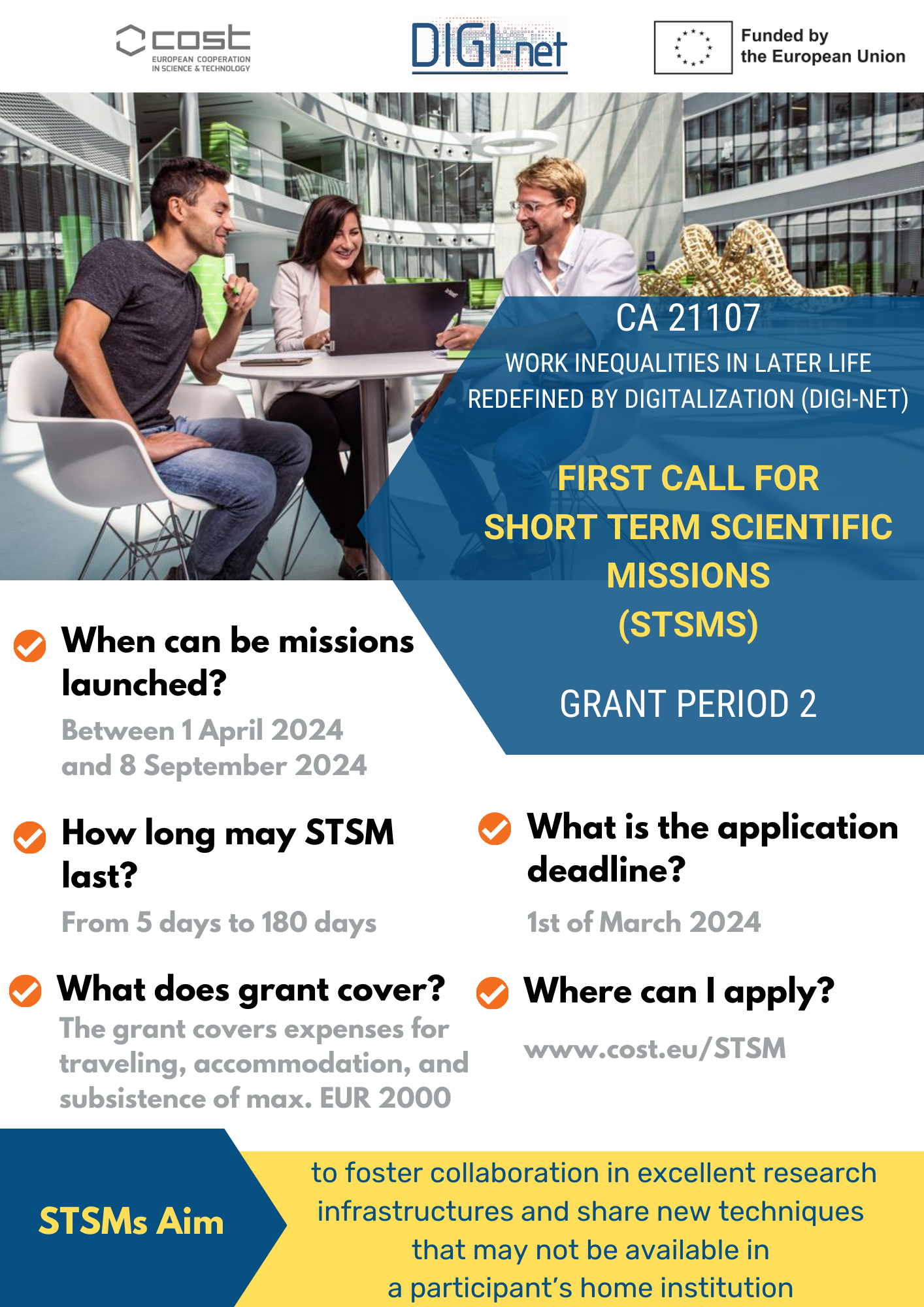
Short-term scientific missions (STSMs) are exchange visits between researchers involved in DIGI-net, allowing scientists to visit an institution or laboratory in another COST Member/Cooperating Member or Near-Neighbour Country joining the Action. These scientific missions are done by researchers or innovators for specific work to be carried out and for a determined period of time: it may last from 5 days to 180 days. Their aim is to foster collaboration in excellent research infrastructures and share new techniques that may not be available in a participant’s home institution or laboratory.
DIGI-net call for STSM
Recently accomplished STSMs (examples)
Technostress in the Ivory Tower among senior academics: How did the academics deal with the difficulties caused by technology?
Ortenca Kotherja’s Short-Term Scientific Mission, held from 20–24 October 2025 at Alma Mater Europaea University in Maribor, strengthened her research skills in digitalisation, social inequalities, and ageing within COST Action CA21107 DIGI‑net. Under the guidance of Prof. Dr. David Bogataj and the research team, she received practical training in systematic literature review methods, including PRISMA, PROSPERO, PICO, database searching, and reference‑management tools. She contributed to a systematic review on social infrastructure in long‑term care and explored methodologies for assessing social innovation. The mission also enhanced her academic writing, project development knowledge, and collaboration within DIGI‑net Working Groups 1 and 5.
Older Workers’ Experiences of Digital Exclusion and Inequality in Higher Education: A Comparative Study of Türkiye and Lithuania
The Short-Term Scientific Mission, carried out by Selçuk Turan under the supervision of Dr Sarmite Mikulionienė at the Lithuanian Centre for Social Sciences from 24–30 August 2025, examined digital exclusion and inequality among older workers in higher education in Türkiye and Lithuania. Activities included literature review, development of culturally sensitive data‑collection tools, and comparative assessment of digital skill barriers, cultural factors, and organisational challenges. The STSM achieved all planned goals, produced a research framework, and prepared tools for the upcoming fieldwork. Planned follow‑up includes ethics applications, data collection in 2025–2026, conference presentation, journal publication, and continued Türkiye–Lithuania collaboration within DIGI‑NET WG2.
Digital Adaptation by mid- to third-age adults, differences and similarities between Cyprus and Poland
The Short-Term Scientific Mission, carried out by Dr Petroula Mavrikiou under the supervision of Assoc. Prof. Katarzyna Leszczyńska at AGH University of Science and Technology in Kraków, from 21–27 September 2025, examined digital adaptation among mid‑ to third‑age adults in Cyprus and Poland. Activities included presenting recent Cypriot survey findings, comparing structural and personal barriers to digital inclusion, and reviewing national good practices. The STSM achieved all planned goals, deepened comparative insights, and initiated a joint working paper. Planned follow‑up includes conference presentation, dissemination through Frederick University, journal submissions, and continued Cyprus–Poland collaboration aligned with COST Action CA21107.
Beyond Retirement: Social, Psychological, Digital, and Structural Predictors of Continued Employment
The Short-Term Scientific Mission, carried out by grantee Lavinia Țânculescu‑Popa under the coordination of Assoc. Prof. Anna Sevcikova at the Institute for Research on Children, Youth and Family at Masaryk University in Brno, from 14–20 September 2025, advanced the empirical work for Beyond Retirement. The mission involved cleaning and harmonising SHARE Waves 8–9 data and developing longitudinal and cross-sectional models on realised retirement and early retirement intentions. Analyses highlighted job satisfaction, health, and financial stability as key predictors. The STSM achieved all goals, produced draft manuscript sections, refined analytical strategies, initiated data‑pooling steps, and strengthened follow‑up collaboration toward publication and conference dissemination.
Age-inclusive innovation and Entrepreneurship
The Short-Term Scientific Mission, carried out by Dr. Eriona Shtembari under the supervision of Prof. Fátima Guadamillas and Prof. Amarildo Zane at the University of Castilla‑La Mancha in Toledo from 14–23 October 2025, advanced research on age‑inclusive innovation and entrepreneurship. Activities included collaboration with UCLM’s innovation faculty and the 50emprende.es initiative, teaching in a master’s programme, and developing comparative analyses on digital inclusion. The STSM achieved all planned goals, strengthened long‑term research partnerships, supported concept development for a 50+ entrepreneurship pilot in Albania, secured a RESER conference presentation, and initiated Erasmus+ cooperation, contributing directly to DigiNet’s objectives on inclusive digital transformation.
Archived STSMs
AI skills for lifelong learning

AI skills for lifelong learning
Dr. Oliana Sula from Aleksander Moisiu University of Durres, Albania, in collaboration with the Research Group Evori Faculty of Education, University of Leon, Spain, examined the topic “AI skills for lifelong learning.”
During the duration of her Short-Term-Scientific-Mission (27 May – 31 May 2024), the following was achieved:
- AI skills for Generation X and Boomers (in line with needs) were developed
- Existing networks and cooperation were fostered & promoted
- Knowledge was exchanged
Digitalization on work inequalities among older workers
Ms. Elena Babasikas (Idrizi) from the University of National and World Economy, Sofia, Bulgaria, in collaboration with the Lithuanian Centre for Social Sciences, explores the impact of “digitalization on work inequalities among older workers”.
During the duration of her Short-Term-Scientific-Mission (12 May – 19 May 2024), the following was achieved:
- Data on how digital technologies affect older workers was collected & analyzed
- Networks & cooperation were intensified (future publications are planned)
- Relationships with stakeholders were established

Work inequalities among older workers in the digital age

Work inequalities among older workers in the digital age
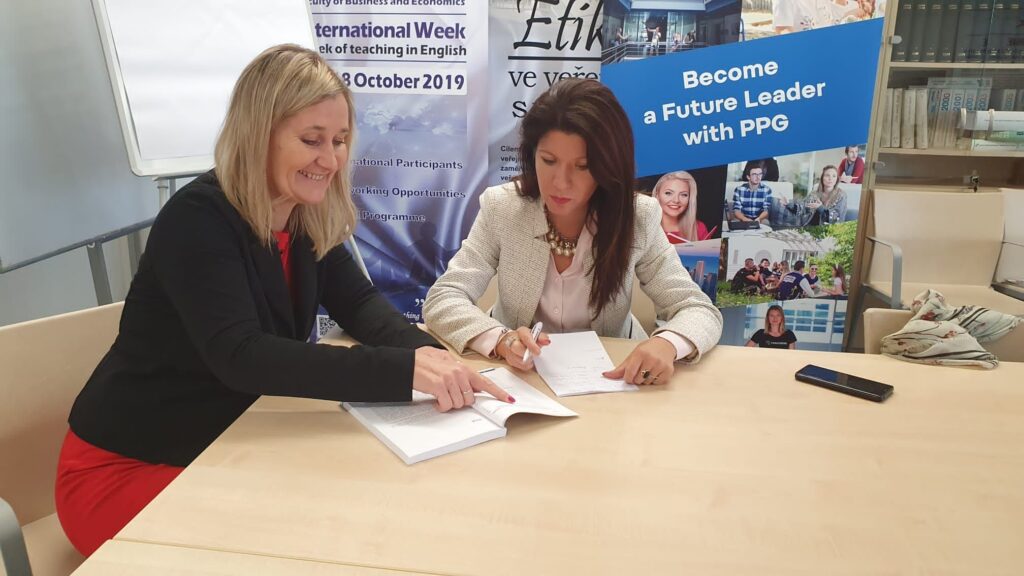
Dr.Ortenca Kotherja, lector at the University of Social Science, Tirane, Albania, and Faculty of Education” Aleksander Xhuvani” Elbasan, Albania, in collaboration with Martina Rasticova, Nataliia Versal, Nataliia Tkalenko, Ondrey Pavelek at the Faculty of Business and Economics at Mendel University in Brno, Czech Republic examined the topic “Work inequalities among older workers in the digital age”
During the duration of her Short-Term-Scientific-Mission (13 May – 18 May 2024) the following was achieved:
- Existing networks were strengthened
- International cooperation were fostered & promoted
- Knowledge in addressing work inequalities were exchanged
Exploring mature (55+) university students’ experiences of work inequalities due to digitalization
Assoc. Prof. Dr Eleni Meletiadou from London Metropolitan University in the UK in collaboration with colleagues at Frederick University in Cyprus dived into researching of the topic “Exploring mature (55+) university students’ experiences of work inequalities due to digitalization”
During the duration of her Short-Term-Scientific-Mission (10 June – 18 June 2024) the key achievements were:
- Existing networks were strengthened
- Collaboration in research infrastructure was fostered
- Long-lasting connection between Cyprus & London were developed
- Knowledge exchange was promoted

Example of STSM: Digitalization in the workplace and its effects on older employees

Example of STSM: Digitalization in the workplace and its effects on older employees
Eriona Shtembari from the University of New York Tirana in collaboration with Matt Flynn at Leicester University, UK and Martina Rašticová at Mendel University, Czech Republic dived into researching of the topic “Digitalization in the workplace and its effects on older employees”
Example of STSM: Technostress among older academic workers
Sylwia Przytula from Poland has completed a Short-Term Scientific Mission at Mendel University in Brno, Czech Republic, in collaboration with Martina Rasticova. During a one-week stay (11th-15th Sep 2023), Sylwia conducted a series of interviews with older scholars, delving into the impacts of technostress in the academic world.